
The Raphael Lemkin Society, with the support of the European Endowment for Democracy, and the Coalition of Culture Actors convened a high-level panel discussion at Lviv Media Forum 2026 examining how attacks on culture function as part of genocidal violence, and how journalists can better document, explain, and expose these processes.
The panel, “Culture as a Target and Tool of Genocide: How Media Can Catch the Moment,” took place on Friday, May 15, as part of LMF’s Frankly Spoken track. The event was organized with support from INDEX: Institute for Documentation and Exchange and the Partnership Fund for a Resilient Ukraine (PRFU).
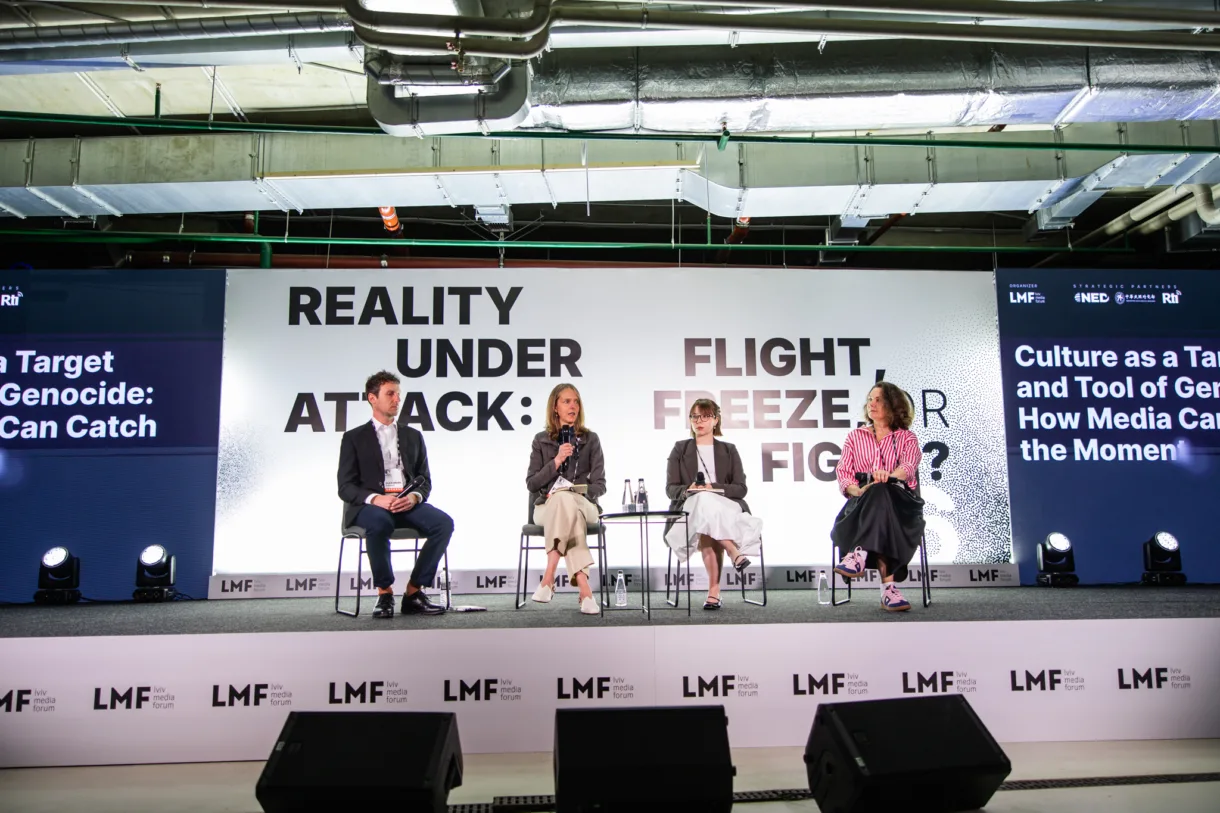
The discussion brought together experts in cultural heritage, international law, accountability, and journalism:
- Fiona Greenland, sociology professor and director of the Cultural Resilience Informatics and Analysis Lab at the University of Virginia;
- Alex Prezanti, barrister at Artemis Chambers (London and legal advisor on investigations and case building at (PRFU);
- Daryna Pidhorna, legal expert and analyst at the Raphael Lemkin Society; and
- moderator Tetiana Pushnova, journalist, media manager and communication adviser for cultural projects.

Opening the discussion, Tetiana Pushnova framed the central challenge: the gap between what societies recognize as genocidal destruction and what international law is currently able to prove. She recalled Raphael Lemkin’s original understanding of genocide as not only mass killing, but the systematic destruction of a group’s culture, institutions, language, memory, and way of life.
“The gap between what we feel to be true and what the law allows us to prove is exactly what we are discussing today,” said Tetiana Pushnova. “Lemkin understood that genocide could begin with the destruction of culture — with language, institutions, churches, schools, memory, and the structures that allow a people to survive as a people.”
Panelists emphasized that Russia’s war against Ukraine cannot be understood solely through the lens of territorial conquest or physical destruction. Attacks on museums, archives, monuments, schools, language, religious institutions, property records, and children’s education form part of a broader system aimed at erasing Ukrainian identity and replacing it with Russian narratives.

“Russia seeks to destroy Ukraine as a social entity, and one of the ways it does this is by destroying the cultural core,” said Fiona Greenland. “The media must move beyond counting damaged sites and tell more comprehensive stories about cultural erasure — stories that connect historical objects, laws, children, communities, and the future society Russia is trying to engineer.”
Greenland highlighted the importance of documenting not only shelling and looting, but also the legislative and bureaucratic mechanisms used by the Russian Federation in occupied territories. She pointed to the forced transfer and re-registration of cultural property, the imposition of Russian language and “traditional values,” and the use of museums and schools to normalize occupation and reshape identity.

Alex Prezanti addressed the limits and possibilities of the existing legal framework. While international law does not currently recognize “cultural genocide” as a standalone crime under the Genocide Convention, he explained that cultural destruction can still be relevant to war crimes, crimes against humanity, and genocide cases — especially when it helps demonstrate intent, mental harm, persecution, or incitement.
“The law as it stands is limited, but it is not useless,” said Alex Prezanti. “Cultural destruction can help show genocidal intent, the severe mental harm inflicted on Ukrainians, and the broader campaign to destroy Ukraine as a separate national and cultural identity. Ukraine can lead the world in changing how we understand genocide, cultural erasure, and accountability.”

Daryna Pidhorna connected the discussion directly to Lemkin’s legacy, emphasizing that his original concept of genocide included the destruction of social and cultural life. She noted that although cultural genocide was removed from the final text of the 1948 Genocide Convention, Ukraine now has both a legal and moral responsibility to push the global conversation forward.
“If we do not understand cultural destruction politically and legally, it will be almost impossible to persuade our partners that international law must change,” said Daryna Pidhorna.“Ukraine must document these crimes not only as individual acts of destruction, but as part of a system that uses culture as a tool of aggression, occupation, and identity transformation.”
The panel also underscored the critical role of media. Speakers called on journalists to avoid reducing cultural destruction to isolated incidents or simple damage counts. Instead, they urged the media to trace patterns, follow legal and bureaucratic changes, investigate education and propaganda targeting children, and show how cultural policies shape everyday life under occupation.


Key Takeaways:
- A legal gap remains. Current international genocide law, including the 1948 UN Genocide Convention, does not explicitly recognize cultural destruction as genocide. Panelists noted that this omission reflects political choices made despite Raphael Lemkin’s broader understanding of genocide as the destruction of a group’s culture, institutions, and way of life.
- Russia’s attacks on Ukrainian culture are systematic. Speakers presented evidence that Russia is targeting Ukrainian culture as part of a broader effort to destroy Ukraine as a social entity. This includes the transfer of cultural property, enforcement of Russian language and “cultural values,” mass removal of artifacts, propaganda, and the re-education of children in occupied territories.
- Cultural destruction can still support legal cases. Although “cultural genocide” is not defined in international law, experts highlighted ways cultural destruction can strengthen cases related to genocidal intent, forced transfer of children, severe mental harm, persecution, and incitement to genocide.
- Narratives can drive legal change. Panelists emphasized that law evolves with public understanding. Journalists, researchers, writers, and cultural actors have a critical role in documenting cultural erasure, telling human-centered stories, and showing how Russia’s war targets Ukrainian identity itself.
- Ukraine can reshape the global debate. The systematic targeting of Ukrainian culture offers a chance to revisit how international law understands genocide. Persistent documentation and advocacy can help shift the view of culture from tradition alone to the foundation of a nation’s social life and identity.
Photos by Nastya Telikova.
Watch the full video recording of the panel here.